


Furukawa Automotive Systems begins delivering High-Voltage Power Distribution Component Modules for Toyota MIRAI (Hydrogen Fuel Cell Vehicle)
- Development of new components supporting the electrification of automobiles contributes to reducing CO2 -
March 15, 2021
Furukawa Electric Co.,Ltd
Furukawa Automotive Sysytems Inc.
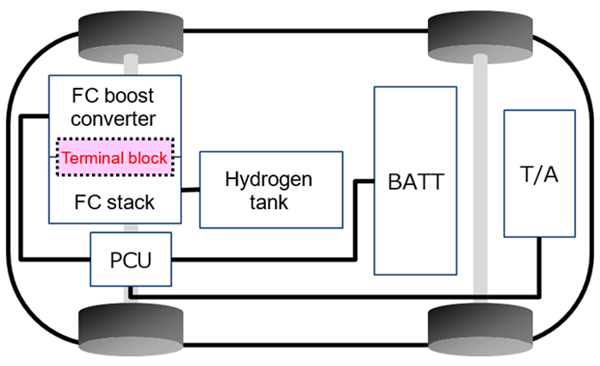
- Furukawa Automotive Systems has begun supplying high-voltage power distribution component modules for use in the FC systems of new Toyota MIRAI model vehicles.
- The highly accurate and compact modules help to make FC system assembly work easier.
- Furukawa Automotive Systems contributes toward promoting the adoption of electric vehicles and achieving carbon neutrality by 2050 through development of automotive components.
Background
Details
Feature 1: Bus bar module method results in high-accuracy and high-density high power transmission
In order to meet this requirement, this product makes use of the bus bar module method in which bus bars are insert molded. Standard copper is used for the conductors, and the product was designed with recyclability in mind. Engineering plastic was chosen as the resin material in order to withstand high-temperature environments, due to its high heat resistance and low thermal stress near the linear coefficient of expansion for copper. Materials were carefully selected and the structural design was optimized, resulting in a highly efficient routing structure and excellent workability during assembly.
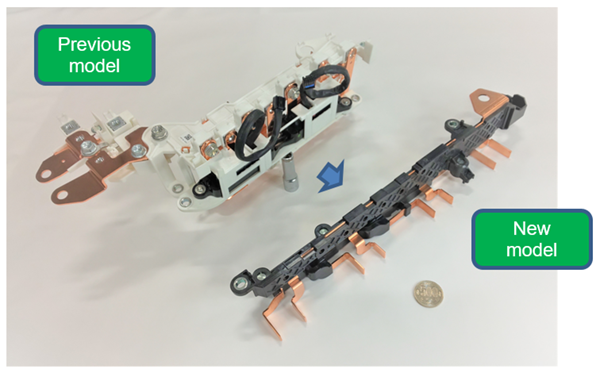
Feature 2: 23% more compact than the previous model
When using insert molding, differences in the linear coefficient of expansion for each component can cause issues with thermal stress due to the heat generated from nearby components and the increase in internal temperature during current loading. In order to prevent resin from cracking due to thermal stress, a thermal stress analysis simulator was used to predict internal stress prior to setting the optimal bus bar layout and resin thickness at each location. A resin flow analysis was also conducted in order to take resin orientation and welding areas into consideration during molding, in an attempt to reduce thermal stress.
Glossary
-
note 1Module: A component with cohesive functionality that integrates multiple components. This product integrates the bus bar that serves as the transmission medium for power, resin components that ensure sufficient insulation performance, and anchoring components (nuts, collars) for other components.
-
note 2Fuel cell (FC) stack: A type of power generator installed in a fuel cell vehicle. A fuel cell generates power through creating a chemical reaction in hydrogen and oxygen. The simplest structural unit of a battery is called a cell. A single cell is capable of generating only a small amount of power, so several hundreds of cells are layered in series in order to obtain the required voltage in actual use. Fuel cells layered in this manner are referred to as an FC stack.
-
note 3Bus bar: A conductor component used to transmit high current. Copper is mainly used as the material. Stamping is used to punch-out or bend strip material into the required shape.
-
note 4Routing: A process by which the routes of bus bars connecting components electrically are designed and arranged to fit within a limited space.
-
note 5Insert molding: A type of molding. A component is inserted into a mold for injection molding and then melted resin is injected around the component. This results in the inserted component becoming integrated with the resin component. Insert molding is used to integrate bus bars, nuts, collars, and resin components in this product.
Furukawa Electric Group’s efforts towards the SDGs
Based on the corporate philosophy of “Drawing on more than a century of expertise in the development and fabrication of advanced materials to contribute to the realization of a sustainable society through continuous technological innovation,” the Furukawa Electric Group is conducting business activities centered on four core technological capabilities (metals, polymers, photonics and high frequency). Moreover, keeping in mind the “Sustainable Development Goals (SDGs)” adopted by the UN, we formulated the “Furukawa Electric Group Vision 2030,” which clarified the business areas of the Furukawa Electric Group, and are advancing efforts aimed at “creating solutions for the new generation of global infrastructure combining information, energy, and mobility to build a sustainable world and make people’s life safe, peaceful, and rewarding.
The information contained in news releases is current at the time of release.
Please note that information regarding specifications, prices and service content, etc., are subject to change without notice.