


Development and Demonstration of World-leading Technologies that Increase Submarine Optical Cable Capacity with Multicore Fiber
- Feasibility of capacity seven times higher than existing systems verified -
March 28, 2022
KDDI Research, Inc.
Tohoku University
Sumitomo Electric Industries, Ltd.
Furukawa Electric Co., Ltd.
NEC Corporation
Optoquest Co., Ltd.
Japan’s Ministry of Internal Affairs and Communications formulated the technical research and development theme II “Multicore high-capacity optical transmission system technology” to support development of innovative optical network technology with a novel social infrastructure (JPMI00316) over FY 2018–2021. As part of this initiative, the Ministry commissioned six organizations: KDDI Research, Inc. (KDDI Research; President and CEO: Hajime Nakamura), Tohoku University (Tohoku University; President: Hideo Ohno), Sumitomo Electric Industries, Ltd. (Sumitomo Electric; President: Osamu Inoue), Furukawa Electric Co., Ltd. (Furukawa Electric; President: Keiichi Kobayashi), NEC Corporation (NEC; President, & CEO: Takayuki Morita), and Optoquest Co., Ltd. (Optoquest; President: Noboru Higashi) to conduct research and development (R&D) to meet the global data distribution demand for increased capacity of submarine optical cable systems, which constitute the principal international data communication infrastructure.
Multicore fibers are optical fibers with multiple light-propagating cores that exhibit higher transmission capacity than conventional optical fibers. This R&D project assessed the transmission capacity of a long-distance optical submarine cable system in the laboratory. We developed submarine optical cables using multicore fibers, compact multicore fiber optical amplifiers, and submarine optical cable performance assessment technology to establish the fundamental technologies needed to increase the capacity of the submarine optical cable system. We demonstrated the feasibility that the multicore fibers enhanced the transmission capacity of a 3,000 km class submarine optical cable system (covering the Asian-Pacific region) to about 1.7 Petabit per second (Pbit/s), seven-fold higher than the existing system(note 1).
This R&D project has established the fundamental technology that facilitates the expansion of global data communication infrastructures utilizing multicore fibers. Furthermore, we will promote R&D for practical applications, including mass production, operation, and maintenance of the infrastructure, with the objective of enabling commercialization of the technology by the mid-2020s.
Background
R&D Overview and Results
* Steps 1, 2, and 4 were announced by the six companies.
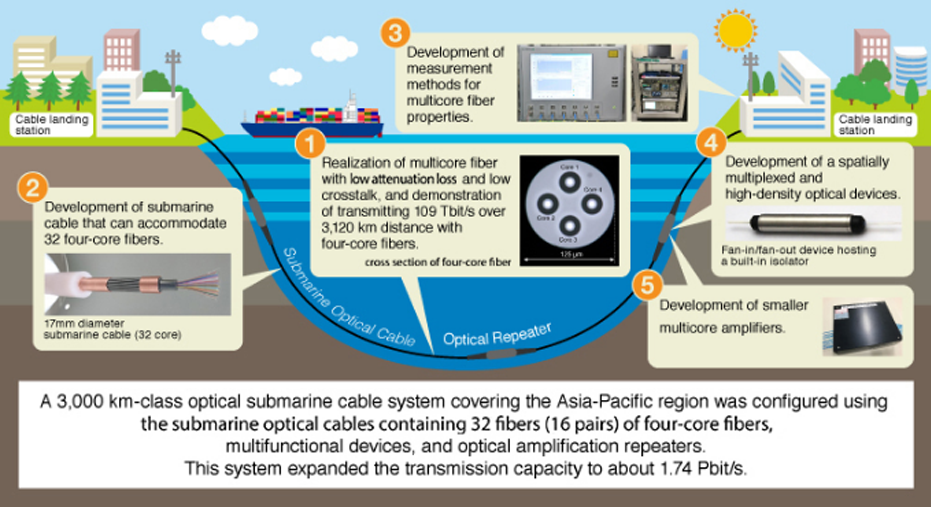
1) Development and demonstration of a multicore fiber-based long-haul transmission system.
We developed multicore fibers with the world’s lowest transmission loss levels. Our multicore fibers contain four cores (four-core fibers), enabling transmission capacity that is four times higher than conventional optical fibers. Additionally, we successfully transmitted ultra-high-speed optical signals over multicore fibers across a transpacific distance. Specifically, successful long-haul multicore fiber transmission at 109 and 56 Terabits per second (Tbit/s) over distances of 3,120 and 12,000 km, respectively, have been demonstrated. As intercore crosstalk has been a major issue in multicore fiber transmission, we optimized the optical fiber structure and manufacturing methods to generate a multicore fiber with lower intercore signal interference. The four-core fiber optic cable exhibited 0.155 dB/km class transmission loss and crosstalk lower than -60 dB/100km.
Realization of Multicore Fiber with Low Crosstalk and Ultralow Attenuation Loss
Furukawa Electric, KDDI Research, November 30, 2020.
We developed the first submarine multicore optical cable system, featuring fibers with significantly higher transmission capacity, while maintaining the same optical fiber size and cable diameter. The cable houses a total of 32 x four-core fibers, enabling up to 128-core high-capacity transmission. Through underwater and long-distance transmission tests assuming actual operational conditions, we have verified the high-quality transmission performance of our multicore fiber cables, while maintaining excellent optical performance, such as lower optical attenuation and intercore crosstalk, after the cabling process.
We developed the world's first multicore fiber optic submarine cable.
NEC, OCC, Sumitomo Electric, October 4th, 2021
We developed three multifunctional device types for the multicore fiber optical amplifiers. The three multifunctional devices for four-core fibers were a) a fan-in/fan-out device hosting an optical isolator, b) a TAP monitoring device with fan-out, and c) a TAP monitoring device having an O/E (optical to electrical) converter. Integration of these functions into a single device enabled ultra-low loss (typically 0.4dB) and compact optical devices (size reduction of 55%) for multicore fiber optical amplifiers.
(Japanese text) Optoquest developed multifunctional optical devices (three types) for multicore fiber optical amplifiers.
Optoquest, October 22, 2021
Conventional multicore amplifiers containing a single-core optical amplifier and a fan-in/fan-out device are large and require gain blocks proportional to the number of cores (note 3). As a result, increasing the capacity of submarine optical cables to meet the growing data transmission demand and accommodating large-sized amplifiers within the submarine cable repeaters has been challenging. Therefore, we developed a smaller multicore optical amplifier and have evaluated its basic optical amplification operation. Our amplifier employs a cladding pumping system, which amplifies multiple cores in one gain block, and by reconfiguring the gain block components we succeeded in lowering the amplifier’s volume by about half when compared to conventional devices.
-
note 1Current long-distance submarine optical fiber cables exhibiting the largest transmission capacity: Dunant (250 Tbit/s)
The Dunant subsea cable, connecting the US and mainland Europe, is ready for service -
note 2Source: TeleGeography
-
note 3The amplified optical signals became weaker during transmission, potentially due to the amplifying medium and the optical components attached to the optical amplifier.
Furukawa Electric Group’s efforts towards the SDGs
Based on the “Sustainable Development Goals (SDGs)” adopted by the United Nations, the Furukawa Electric Group has formulated the “Furukawa Electric Group Vision 2030” which sets the year 2030 as its target and is advancing efforts with the aim to “Build a sustainable world and make people’s life safe, peaceful and rewarding, Furukawa Electric Group will create solutions for the new generation of global infrastructure combining information, energy and mobility.” Toward the achievement of our Vision 2030, we will take open, agile, and innovative approaches to promote ESG management that that aims to increase corporate value over the medium to long term and will contribute to the achievement of the SDGs.

The information contained in news releases is current at the time of release.
Please note that information regarding specifications, prices and service content, etc., are subject to change without notice.