


Utilization of ultrawide bands to increase the capacity of optical fiber communication: The world’s first successful O-band coherent high-density wavelength division multiplexing transmission experiment
- With this method, equipment configuration is reduced to half that of the conventional configuration. In addition, power consumption for inter-data center communication is expected to be reduced. -
May 18, 2023
KDDI Research, Inc.
Furukawa Electric Co., Ltd.
OFS Laboratories, LLC
This result enables optical fiber communication to be used for large-capacity communication between data centers, which are often connected over distances of up to 80 km. Moreover, the power consumption of this communication is also expected to be reduced compared to standard approaches.
Background
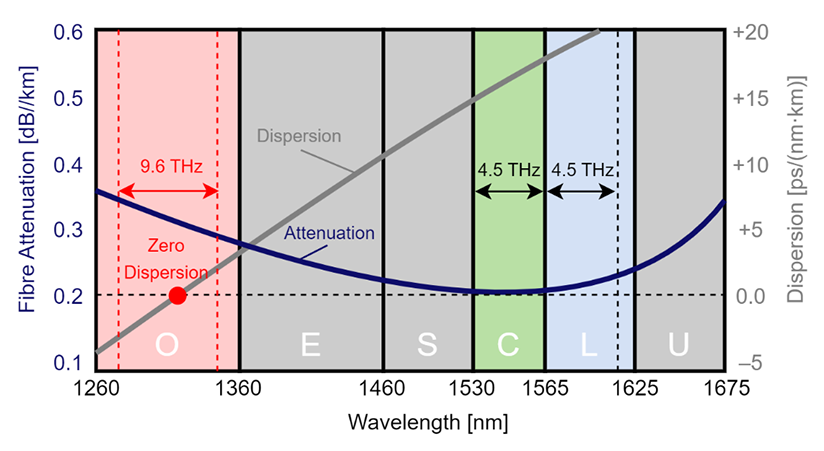
In this context, the use of the O-band has gained attention. Optical signal transmission using the C-band and L-band requires heavy-load digital signal processing to compensate for signal distortion due to wavelength dispersion(note 3). However, wavelength distortion has a smaller impact on the O-band, a wavelength band near-zero dispersion, thus reducing the load on digital signal processing and improving energy efficiency.
In contrast, coherent transmission technology uses the optical phase in addition to the intensity of light to enable high-speed and large-capacity communication. However, the optical phase is easily distorted by other optical signal components, and this effect is stronger closer to zero-dispersion wavelengths. The nonlinear noise created by this phenomenon is generally difficult to remove with digital signal processing techniques, reducing the overall performance of the system. Therefore, it is difficult to apply coherent transmission technology in the O-band.
Content
Results
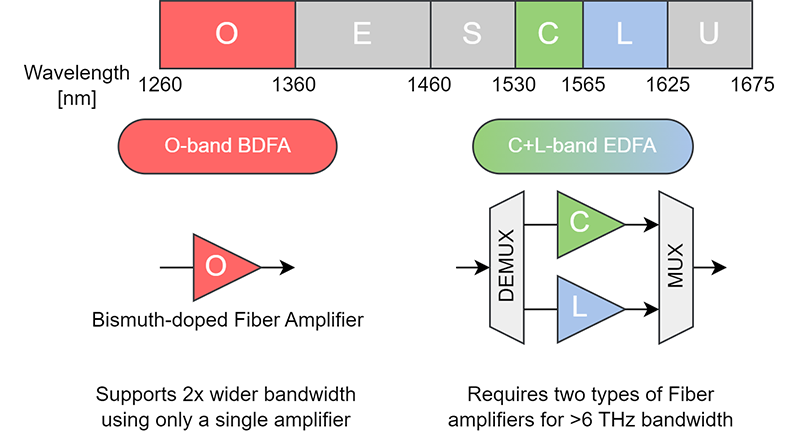
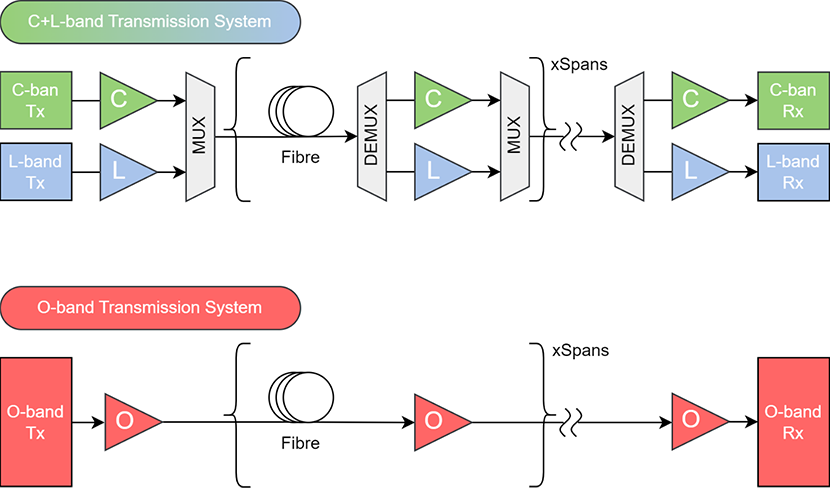
Through this experiment, it was confirmed that the O-band coherent DWDM transmission system can achieve the same or higher wideband and high-capacity transmission with lower power consumption, while using only half of the conventional wideband transmission equipment configuration that uses C+L bands.
The minimization of nonlinear noise in the O-band was achieved by appropriately setting the optical transmission power for each densely multiplexed wavelength signal. This process has demonstrated the possibility of multiplexing up to 190 wavelength channels with a high throughput of over 240 Gbps on average, minimizing the effects of nonlinear noise, even when the processes of transmitter-side signal compensation and receiver-side wavelength dispersion compensation are omitted. As a result, O-band coherent DWDM transmission with a large capacity of over 40 Tbps has been made possible.
Compared to EDFA (erbium-doped fiber amplifier), i.e., the industry standard for optical fiber amplifiers that can amplify only the C-band or L-band, BDFA can provide the same or better amplification with better noise figures over the entire O-band (which is wider than the C-band and L-band combined). This experiment showed that an ultrawide bandwidth comparable to the C+L band can be achieved by amplifying coherent DWDM signals over 9.6 THz in the O-band.
Future Outlook
These results were reported as a postdeadline paper(note 4) for OFC2023 (Optical Fiber Communication Conference & Exposition), the world’s largest international conference on optical communication technology, held from March 5, 2023 to March 9, 2023.
This experiment will be introduced at the KDDI Research booth at “Wireless Japan 2023 x Wireless Technology Park 2023,” which will be held at Tokyo Big Sight (Koto-ku, Tokyo) from May 24, 2023 to May 26, 2023.
-
note 1The world’s first successful coherent dense wavelength division multiplexing transmission experiment using a bandwidth of 9.6 THz in the O-band (as of May 18, 2023, conducted by KDDI Research, Inc.).
-
note 2Coherent dense wavelength division multiplexing (DWDM) transmission technology: Coherent transmission technology is a method of transmitting a larger volume of data than conventional intensity-modulation direct-detection technology by utilizing the wave properties of light as well as the light intensity. DWDM is a method of densely multiplexing wavelengths in WDM technology, which increases the transmission capacity of optical fibers.
-
note 3Wavelength dispersion: A phenomenon in which the speed of light waves propagating through an optical fiber differs depending on the wavelength.
-
note 4Postdeadline papers: Papers accepted after the general paper submission deadline (postdeadline). During the conference, the selection of papers is conducted, and only research papers that receive a high evaluation will be reported.
Furukawa Electric Group’s efforts towards the SDGs
Based on the “Sustainable Development Goals (SDGs)” adopted by the United Nations, Furukawa Electric Group has formulated the “Furukawa Electric Group Vision 2030” which sets the year 2030 as its target and is advancing efforts with the aim to “Build a sustainable world and make people’s life safe, peaceful and rewarding, Furukawa Electric Group will create solutions for the new generation of global infrastructure combining information, energy and mobility.” Toward the achievement of our Vision 2030, we will take open, agile, and innovative approaches to promote ESG management that aims to increase corporate value over the medium to long term and will contribute to the achievement of the SDGs.
The information contained in news releases is current at the time of release.
Please note that information regarding specifications, prices and service content, etc., are subject to change without notice.