


World’s First Successful Experiments in Ultrawideband Optical Fiber Transmission at 115.2 THz, 24 Times Broader than Conventional Bandwidth
- Supporting high-capacity, high-speed communication between data centers in the 6G era -
October 20, 2023
KDDI Corporation
KDDI Research, Inc.
Sumitomo Electric Industries, Ltd.
Furukawa Electric Co., Ltd.
OFS Laboratories, LLC
In the 6G era, it is expected that far more and diverse data will flow through networks than at present due to the spread of IoT (Internet of Things) devices and mobility services, and it is essential to further expand the capacity of optical fiber communication to support networks. The success this time is in technology for supporting high-capacity, high-speed communication between data centers in the 6G era. Furthermore, the same transmission capacity can be secured with fewer fiber cores since the transmission capacity per optical fiber can be greatly expanded, and this technology is expected to enable the use of ordinary conduits and facilities with less space occupied.
Background
Transmission capacity per optical fiber can generally be increased by using wavelength division multiplexing, in which the wavelength of light is slightly changed for multiplexed transmission.
Until now, KDDI Research, Sumitomo Electric, and Furukawa Electric have been working toward practical application of multi-core optical fibers, which have multiple cores in a single optical fiber (note 4). In March 2023, KDDI Research, Furukawa Electric, and OFS conducted successful O-band coherent dense wavelength division multiplexing (DWDM) transmission (note 5) experiments to utilize the O-band, which has approximately twice the transmission bandwidth of the C- and L-bands (note 6). Furthermore, in March 2023, Sumitomo Electric presented a high-density uncoupled 12-core optical fiber with a coating diameter of 250 μm, the same diameter of standard optical fibers, making it ideal for creating high-density optical cables (note 7).
Results this time
Appendix: Roles of the individual companies
KDDI and KDDI Research
Furukawa Electric and OFS
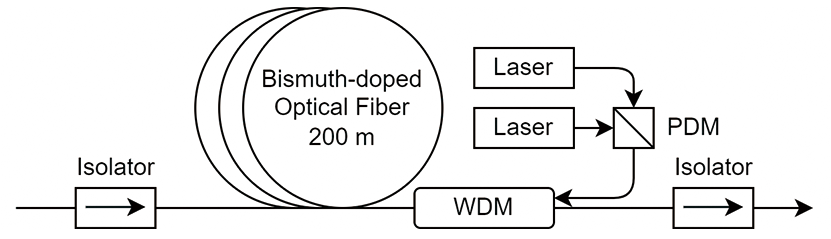
WDM: Wavelength Division Multiplexer, PDM: Polarization Division Multiplexing
Sumitomo Electric
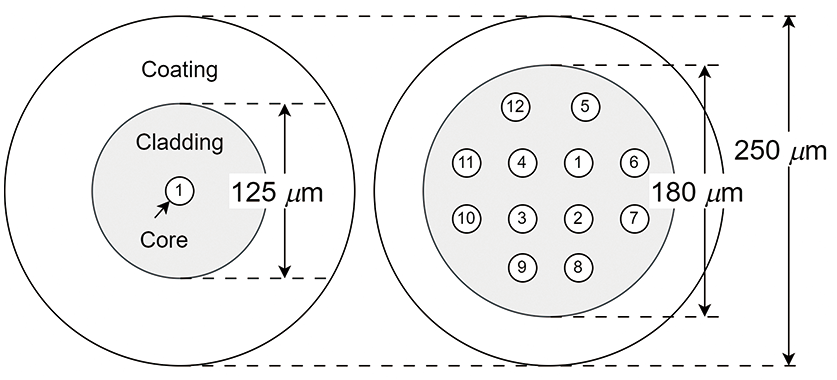
250 μm coating outer diameter as conventional optical fiber (left)
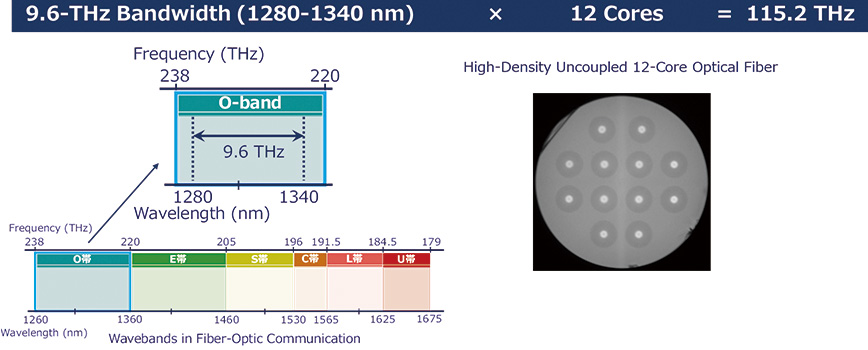
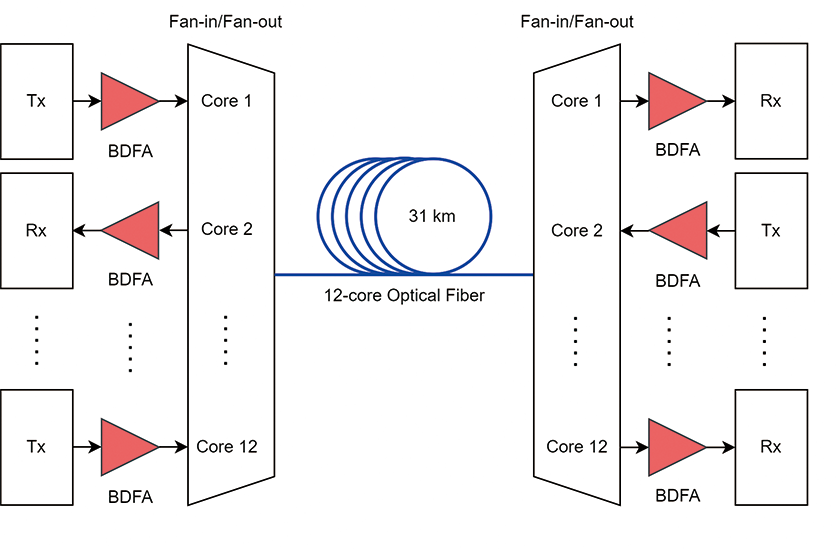
Wavelength division multiplexing of more optical signals is effective in increasing the capacity of optical fiber communication, but this requires optical fiber amplifiers that can amplify a broader wavelength band. The BDFA developed by Furukawa Electric and OFS can amplify optical signals over the entire O-band, which is broader than the C-band and L-band combined. This experiment showed that an ultrawideband comparable to the C+L band can be achieved by amplifying coherent DWDM signals over 9.6 THz in the O-band.
Furthermore, by applying multi-core optical fiber, in which multiple cores that are paths for optical signals are arranged in a single optical fiber, the transmission capacity per optical fiber can be expanded by the number of cores. Sumitomo Electric has focused on the fact that optical signals in the O-band are more strongly confined by the core than in the C-band, and it has developed an uncoupled 12-core optical fiber with 12 independent cores densely clustered within the standard optical fiber outer diameter of 250 μm.
It was demonstrated that, by combining these three technologies, the total available bandwidth per optical fiber can be extended to 115.2 THz, and a 484 Tbps high-capacity transmission experiment was successfully conducted as one example. This is the world’s largest bandwidth and transmission capacity in a demonstration experiment for a single wavelength band, not a combination of multiple wavelength bands.
Future outlook
-
note 1Surveyed by KDDI Research on October 20, 2023
-
note 2Multi-core optical fiber with standard coating diameter that can use existing optical cables.
-
note 3Post-deadline paper: A paper accepted after the general paper submission deadline (post-deadline). Paper selection is conducted during the conference period, and only highly rated research results are given the opportunity to be reported.
-
note 4Press release on March 28, 2022
Development and Demonstration of World-leading Technologies that Increase Submarine Optical Cable Capacity with Multicore Fiber. -
note 5Coherent dense wavelength division multiplexing (DWDM) transmission: Coherent transmission is a method of transmitting a larger volume of data than conventional intensity modulation-direct detection technology by using the properties of light as waves as well as the light intensity. Dense wavelength division multiplexing (DWDM) is a method of densely multiplexing wavelengths in WDM (Wavelength Division Multiplexing) technology, which increases the transmission density of optical fibers.
-
note 6
-
note 7T. Hayashi, A. Inoue, Y. Suzuki, Y. Norisugi, K. Kawamoto, J. Takano, T. Nagashima, T. Hirama, K. Takeda, Y. Shimoda, and F. Sato, "Ultra-High-Density Microduct Cable with Uncoupled 12-Core Fibers with Standard 250-µm Coating," in Optical Fiber Communication Conference (OFC) 2023, Technical Digest Series (Optica Publishing Group, 2023), paper Tu2C.2.
Ultra-High-Density Microduct Cable with Uncoupled 12-Core Fibers with Standard 250-µm Coating -
note 8Wavelength dispersion: A phenomenon in which light propagates at different speeds at different wavelengths. Since optical signals contain slightly different wavelength components, the longer the propagation distance, the more the optical signal distorts due to wavelength dispersion.
-
note 9Nonlinear optical effect: A phenomenon in which an optical signal interferes with a component of its own optical signal or a component of another optical signal multiplexed to a different wavelength, causing distortion of the optical signal.
Furukawa Electric Group’s efforts towards the SDGs
Based on the “Sustainable Development Goals (SDGs)” adopted by the United Nations, Furukawa Electric Group has formulated the “Furukawa Electric Group Vision 2030” which sets the year 2030 as its target and is advancing efforts with the aim to “Build a sustainable world and make people’s life safe, peaceful and rewarding, Furukawa Electric Group will create solutions for the new generation of global infrastructure combining information, energy and mobility.” Toward the achievement of our Vision 2030, we will take open, agile, and innovative approaches to promote ESG management that aims to increase corporate value over the medium to long term and will contribute to the achievement of the SDGs.
Inquiries
The information contained in news releases is current at the time of release.
Please note that information regarding specifications, prices and service content, etc., are subject to change without notice.