


Furukawa Electric Develops Low-Young’s-Modulus, Heat-Resistant Oxygen-Free Copper “TOFC™”
- Contributing to the enhanced performance of power semiconductor modules by low Young’s modulus, high heat resistance, and high thermal conductivity -
November 27, 2025
- The stiffness of oxygen-free copper can be maintained even at temperatures exceeding 300 °C, reducing warpage and deformation
- Low Young’s modulus reduces thermal stress at the bonded interfaces with materials having different coefficients of thermal expansion, thereby significantly improving bonding reliability by suppressing delamination
- Mass production and commercial sales are scheduled to commence within fiscal year 2025
Background
However, exposure to elevated temperatures during soldering or resin bonding processes causes softening and warpage, leading to reduced bonding reliability. Furthermore, differences in the coefficients of thermal expansion between copper and other materials, such as semiconductor chips, ceramics and resins in the module generate thermal stresses during operation, which can cause delamination or cracking at the bonded interfaces between materials, ultimately leading to malfunction.
Details
Furukawa Electric will continue to supply high-performance oxygen-free copper strip products for a wide range of applications, contributing to the advancement and performance enhancement of power semiconductor modules.
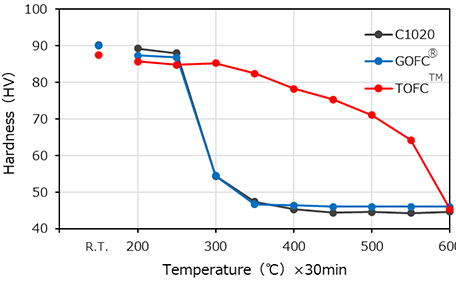
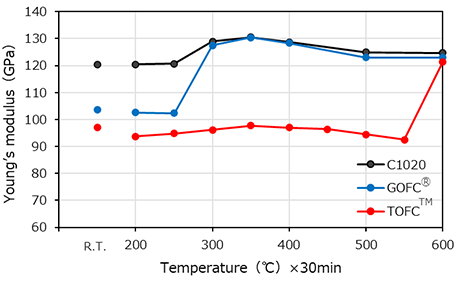
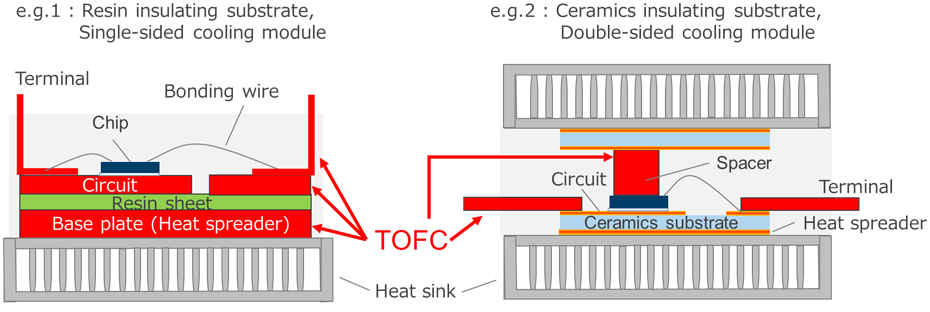
| Electrical Conductivity (%IACS) |
Thermal Conductivity (W/m・K) |
Tensile Strength (MPa) |
Heat Resistance Temperature (℃) |
Young’s Modulus (GPa) |
Product Thickness (mm) |
Features | |
|---|---|---|---|---|---|---|---|
| C1020 | 101 | 391 | 220 - 315 | 200 - 300 | 120 | - | - |
| GOFCⓇ | 101 | 391 | 200 - 300 | 200 - 300 | 100 | 0.25 - 2.0 | Suppresses crystal grain growth |
| TOFC™ | 101 | 391 | 180 - 240 | 500 | 85 | 0.25 - 2.0 | High heat resistance, low Young’s modulus |
(note) Young’s modulus is the proportionality constant between stress and strain during elastic deformation, also referred to as the longitudinal elastic modulus. This represents the stiffness of a material and its resistance to deformation. A higher value indicates greater stiffness and resistance to deformation.
“TOFC” is a trademark of Furukawa Electric Co., Ltd. (application pending).
“GOFC” is a registered trademark of Furukawa Electric Co., Ltd. in Japan.
Furukawa Electric Group’s efforts towards the SDGs
Based on the “Sustainable Development Goals (SDGs)” adopted by the United Nations, Furukawa Electric Group has formulated the “Furukawa Electric Group Vision 2030” which sets the year 2030 as its target and is advancing efforts with the aim to “Build a sustainable world and make people’s life safe, peaceful and rewarding, Furukawa Electric Group will create solutions for the new generation of global infrastructure combining information, energy and mobility.” Toward the achievement of our Vision 2030, we will take open, agile, and innovative approaches to promote ESG management that aims to increase corporate value over the medium to long term and will contribute to the achievement of the SDGs.
The information contained in news releases is current at the time of release.
Please note that information regarding specifications, prices and service content, etc., are subject to change without notice.