


Development of SCB-PPS, a new addition to the lineup of Smart Cellular Board low dielectric materials
July 29, 2025
- Requirements for the materials used in base stations are becoming more sophisticated because of increased telecommunications traffic and advances in 5G/Beyond 5G
- Using PPS plastic, we developed SCB-PPS with low dielectric, lightweight, high heat resistance and flame retardancy
- Through material development leveraging our original technology, we will contribute to realizing a Beyond 5G/6G society
Background
Details
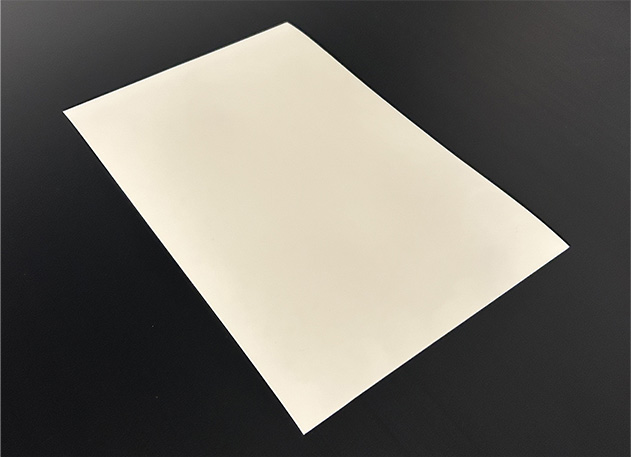
SCB-PPS has heat resistance and flame retardancy on the same level as the solder heat resistance inherently possessed by solid PPS, while the dielectric constant (Dk) and dissipation factor (Df) have been reduced by about 40% and density has been reduced by about 70% compared to solid PPS. With these properties, SCB-PPS can be safely used near high output devices, including the base station radome and antenna circuit board and in hot environments such as outdoor locations. In addition, this material will contribute to further reducing dielectric loss at high frequencies used for 5G and 6G telecommunications(Note) and the structural load of base stations, which often face installation restrictions. Also, because this new material can resist high temperatures during processing, it should be possible to use it in applications including flexible printed circuit boards. We plan to start shipping samples of SCB-PPS in August 2025.
Going forward, we will continue to leverage our original technology to develop materials such as SCB that respond to customer requirements and contribute to the realization of a Beyond 5G/6G society.
| Item | Unit | Physical property | |
|---|---|---|---|
| Density | g/cm3 | 0.4 | |
| Melting point | ℃ | 275 | |
| Tensile strength | MPa | MD | 22 |
| TD | 15 | ||
| Tensile elongation | % | MD | 32 |
| TD | 30 | ||
| Dielectric constant Dk@2.45GHz | - | 1.6 | |
| Dissipation factor Df@2.45GHz | - | 0.0015 | |
| UL-94 flame retardancy (Version 5) | - | V-0 | |
| Thickness | mm | 0.8 | |
* Table does not indicate specification values. Because the material is still under development, the target values may change.
(Note) Dielectric loss=k × f × √Dk × Df (k: Constant, f: Frequency, Dk: Dielectric constant, Df: Dissipation factor)
Low dielectric foam material Smart Cellular Board(SCB)
Related news release
Furukawa Electric Group’s efforts towards the SDGs
Based on the “Sustainable Development Goals (SDGs)” adopted by the United Nations, Furukawa Electric Group has formulated the “Furukawa Electric Group Vision 2030” which sets the year 2030 as its target and is advancing efforts with the aim to “Build a sustainable world and make people’s life safe, peaceful and rewarding, Furukawa Electric Group will create solutions for the new generation of global infrastructure combining information, energy and mobility.” Toward the achievement of our Vision 2030, we will take open, agile, and innovative approaches to promote ESG management that aims to increase corporate value over the medium to long term and will contribute to the achievement of the SDGs.
Inquiries about product
The information contained in news releases is current at the time of release.
Please note that information regarding specifications, prices and service content, etc., are subject to change without notice.