

To be a pioneer in a new era of light: Lightera challenges the AI and data center markets as a global company

Lightera, a company conducting the operating optical fiber and cable businesses globally, marked the first anniversary of its launch on April 1, 2025. Over itsthe first year, the market environment surrounding optical communications underwent drastic changes, driven by the evolution of AI and growing demand for data centers. Lightera has delivered steady results under those circumstances and strengthened its presence in the market. Holly Hulse, CEO of Lightera, gave an interview and shared the company’s vision as well as its journey to date.
-

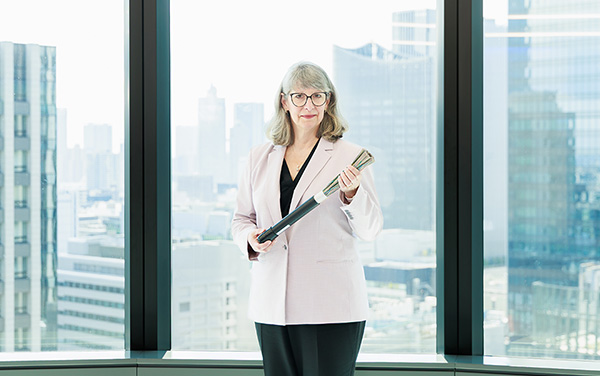
- Holly Hulse
- CEO of Lightera and Corporate Vice President of Furukawa Electric
Appointed President of OFS FITEL in July 2022, and Corporate Vice President of Furukawa Electric and President & COO of Lightera in April 2025. CEO of Lightera and Corporate Vice President of Furukawa Electric since April 2026.
“Becoming a more global company” — Why Lightera was born
—First, please introduce yourself. Could you tell us about your background?
Holly: My background is primarily in engineering. I studied astronautical engineering, a field that demands extremely precise design and advanced technical expertise. But I wanted to do more than just master the technology; I wanted to deeply understand how that technology drives society and the economy from a business perspective as well, so I went back to school to get an MBA in business.
My career path has spanned everything from working in the field to executive management. I started my career in manufacturing process engineering, then have been deeply involved in a wide range of areas, from application engineering, marketing, sales, through to general management.
I am confident that my engineering background has cultivated a mindset that allows me to approach problems in a highly systematic way. In the business world, a range of challenges arise every day. Whether the problems are complex interpersonal friction, strategic hurdles in sales, or purely technical barriers, I consistently apply the problem-solving approach I learned as an engineer. I break down the issue, identify the root cause, and derive a solution through a logical process. This consistent approach is my greatest strength.
Furthermore, the products we currently handle are optical fibers and related products that require extremely high levels of technical expertise. As a business leader, I don’t need to be the expert in fiber design, but I do need to understand what technologies are currently in demand in the industry, what trends are becoming mainstream, and the specific manufacturing contexts from which they emerge. I am convinced that making decisions based on a thorough understanding of the essence of technology directly drives the company’s growth.
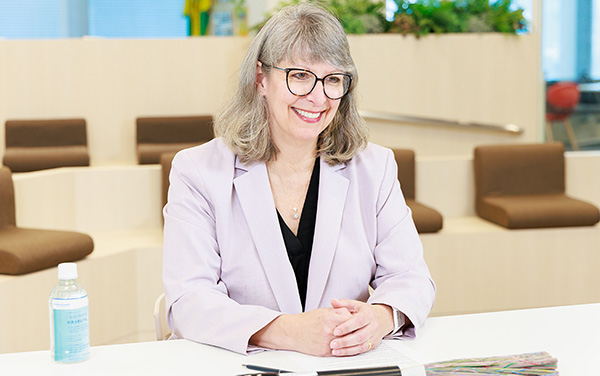
——From your perspective as a leader with a technical background, what was your initial impression of Furukawa Electric, a long-established Japanese company?
Holly: I was appointed Corporate Vice President of Furukawa Electric in 2025 and named CEO of Lightera effective April 1, 2026. I have responsibility for global operations and strategic direction of Lightera. The process leading up to this position was incredibly exciting.
When I interviewed for this role, I was working at OFS, a Furukawa Electric Group company based in the US and Europe. Later, in 2025, we formed Lightera, bringing in a few other companies from the Group’s optical fiber and cable portfolio. I still remember clearly the conversations during the interviews prior to the global integration. At that time, Furukawa Electric presented a very powerful and clear vision, which was to evolve into a more global company.
I felt great expectation and excitement at the determination of Furukawa Electric, a Japanese company with a long history, to transform itself into a true leader in the global market. I felt that it was very exciting to have an opportunity to be part of that shift to this new era together during this pivotal moment of rebirth into a new company. That gave me, as a business leader and as a person, a sense of joy and mission that could not be greater.
——Could you please tell us more about Lightera that you lead.
Holly: Lightera is a company that provides comprehensive solutions across three key areas: fiber, cables, and connectivity. In addition to the traditional telecommunications sector, which is our historical business, recently we’ve become very active in data center and AI-driven businesses, which have seen explosive growth in recent years. Furthermore, we deliver optimal solutions in highly specialized and niche fields, such as aerospace and healthcare, where the highest levels of reliability are required.
When establishing Lightera, we faced significant challenges to integrate the different organizations. We had been very successful working as the separate business units of OFS, Furukawa Electric in Latin America (FEL), and Furukawa Electric’s Optical Fiber and Cable Products Division. We have not changed the brand name of their product lines. They are known in the market, they are long established, and we want to protect that legacy.
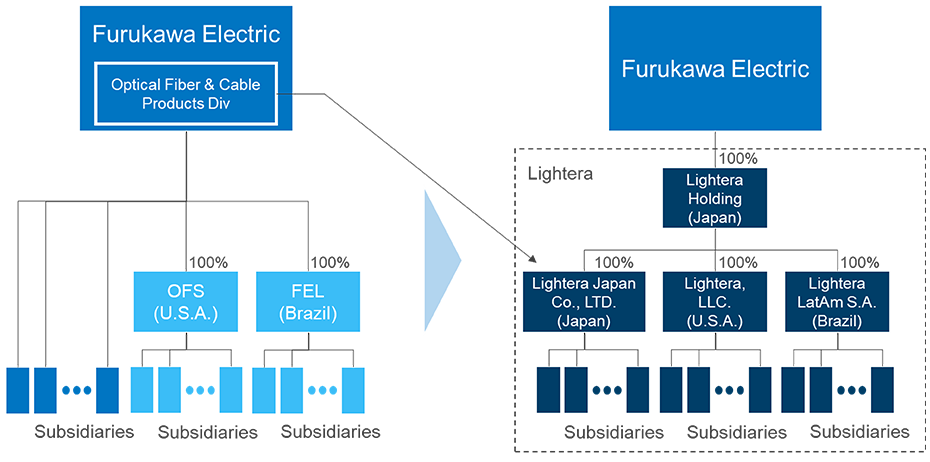
However, a company name is something that we felt was necessary. Each company had a different name. When we’re trying to act as one, if we have a different name on the back of our t-shirt, it feels like we are playing for different teams. So we knew we needed to have one name for everybody in the business to unify our identity as a truly global enterprise.
When deciding on the new name, I didn’t think that should be a top-down decision. We asked our employees all over the world, “What name would you like to see?” and they submitted more than 400 different ideas about possible new names for the company. This process itself was a crucial step in integrating the organizations.
We carefully reviewed the 400 ideas and narrowed them down to a few final candidates. Some evoked the traditional businesses of Furukawa Electric, while others had a completely new sound. We surveyed people in focus groups around the world to understand the impressions these names could convey.
Interestingly, two names received almost the same number of votes, so there was no clear winner. We talked among the executive team of the company, and then we met with President Moridaira of Furukawa Electric. We said, “We have two names, and we have to choose between them.” President Moridaira, however, spoke some very encouraging words. “I will not make the choice. You are running the company; you need to decide what to call the company.”
That said, we asked, “What is your personal preference?” He replied, “When I hear Lightera, I think fresh light combined with era, so I think optical solutions. I think of the future. I like Lightera.” The rest of the team already preferred Lightera. Now that we were aligned with President Moridaira, it became very easy. We thought that Lightera really positioned this company as an optical solutions business for the future, and that’s how we landed on this name.
We also poured a great deal of attention into the logo design. While many of our competitors use blue or red, we deliberately chose an impressive and elegant purple to pursue a completely new look. This choice has been very well received at trade shows and other events, and it is highly regarded by the market as a symbol of our innovation and our distinct presence that set us apart from other companies.

The fusion of different cultures creates Lightera’s strength
——One year has passed since Lightera’s launch in April 2025. This past year has been challenging for Furukawa Electric, while it has also been a period of dramatic upheaval in the global landscape. Could you reflect on the progress you have made during this period?
Holly: Reflecting upon this past year, I think we have to learn to be flexible and agile, and we have to be willing to act more quickly.
One of the biggest challenges that we face today is that the demand driven by the pace of growth of data centers and AI is far exceeding supply. If we could produce twice as much as we do today, we could still sell all of it.
So, a big challenge in 2025 and onwards is managing customer expectations and honoring our commitment to customers. The phrase that we use very often is, “We want to under commit and over deliver.” If we prioritize short-term profits by making overly ambitious commitments and subsequently fail to deliver, we risk instantly losing the trust we have built over the past 100 years.
For this reason, we maintain constant, honest dialogue with our customers. Even in response to urgent requests such as, “We need it right now,” we do not claim the impossible is possible. Instead, we propose concrete and realistic alternatives, such as, “Immediate delivery is difficult, but we can definitely deliver this quantity in three months.” We believe that this highly transparent communication is the foundation of long-term partnerships.
At the same time, we are evaluating expansion opportunities. But we are seeing shortages from our suppliers and cost increases in the value chain. So, we are making every effort to stay on top of the market, to understand what’s happening, to respond as quickly as we can, and to let Furukawa Electric headquarters know what support we need to try to better serve customers and grow the business.
——Could you tell us more about the organizational structure you have built over the past year?
Holly: As I mentioned earlier, prior to the establishment of Lightera, the divisions in Latin America, North America and Europe, and Japan were each successful as separate business entities. Each location had its own technical team and was proud of its expertise in specific product areas.
However, we believed that the best way to win in the global market and the best way to serve our customers was to bring all the companies together, so that we could be a single company facing the customer. We could then offer them a wide range of solutions, instead of just small offerings. So that was the vision.
Of course, this transformation will take time. Because we’re asking people to work differently. We’re asking people to share their ideas openly. In the past, maybe they felt, this is my company, my idea. Now they need to shift their mindset and share with their colleagues around the globe.
To bring this vision to life, we have adopted a matrix leadership structure. Specifically, we have divided the world into regions (Lightera’s global divisions for business and organizational operations), namely, Asia Pacific, Latin America, EMEA (Europe, Middle East, and Africa), North America, and Specialty Photonics. Each region conducts sales and operations locally.
Besides that, we have eight corporate functions, and these corporate functions are working to align our processes and our priorities across the four regions. So, these are, like finance, HR, strategy, technology, and these global functions are helping to weave a thread that connects all of the regions into One Lightera.
When it comes to engaging with the customer, we place equal emphasis on the depth of our engagement with customers within each region. For example, NTT is an extremely important customer for us in Japan. We have a long history of creating innovation together. We will continue to honor and respect that tradition as a valuable asset of the Furukawa Electric Group.
At the same time, some of the data center customers want a global base, so we have a single global account manager who handles these large-scale operators, known as hyperscalers, to make sure that we can bring all of Lightera together to serve them. We also partner with people in other parts of Furukawa Electric who may also be supporting the data center market, so that we not only present what Lightera can do but what all of the Group can do, in order to break through into these data center markets.

——What kind of differences in output arise when people from different cultural backgrounds share ideas?
Holly: It undoubtedly evolves into something stronger and more refined. This is because the challenges faced and the solutions developed vary by region, allowing us to view a single issue from multiple perspectives.
For example, an engineer from Brazil is trained differently than an engineer in Japan or in the US, so they each have different ways to approach problems. It allows us to think more broadly and more deeply as we face challenges and seek solutions. So, it’s that diversity of experience and diversity of backgrounds that make us stronger as a company. I absolutely believe that we are better off as a result of that.
However, that doesn’t mean that it’s easy. The time difference alone – we have phone calls early in the morning, very late at night. We have language barriers that we have to overcome. Above all, it requires patience to respect each other’s different work styles.
The Brazilians always want to insert their opinion very quickly, interrupting and sharing their ideas. The Japanese are very patient; they wait to participate. We’re trying to find new ways of working together as Lightera that blend the best aspects of these different cultures.
Fortunately, technology is on our side today – platforms like Microsoft Teams, real-time simultaneous interpretation, and advanced translation tools. We’re leveraging these to reduce the barriers to communication. It is still challenging, but I’m delighted that we’re trying to do this now. It would have been much more difficult 20 years ago.
From telecommunications to data center market: Lightera’s mindset has shifted over the past year
——The products you have built by listening to customers and pooling the wisdom of your diverse employees are a perfect fit for the current era. Is that correct?
Holly: Yes, I fully agree with your observations. And interestingly, our customer base is changing, which adds a whole new dynamic.
Historically, we have served telecommunication customers. In the last few years, the data center customers have come to us with different expectations, in terms of capacity, in terms of design, and in terms of lead times, so that is shifting the way that we work.
An important part of our market is submarine cable. In the past, that has been about connecting two continents with telecommunications needs, and it was funded by telecommunication company operators. But now the people that are funding all of this business are the data centers, because they need to connect their data centers from continent to continent. The primary investors have shifted to hyperscalers.
While we build upon existing products, given that our customer base is changing at such a rapid pace, we must constantly pause and deeply examine what is happening in the market and what we need to change.
——Could you share your self-assessment over the past year?
Holly: I think we had some very big successes in our first year. However, I think that we uncovered some areas of opportunity for improvement as well, and that’s probably very healthy.
If I think about the successes, we have really changed the mindset of the company from dealing with traditional telecom customers to focusing on data center growth and understanding what that means. I think that everyone from the top to the bottom of the company understands that shift. We had to shift our focus to data centers because that’s where the growth is, and we want to see this company grow. Furukawa wants that and our investors want that, so we really needed to pivot to make sure the data center became the primary focus of Lightera. So that vision has been realized, and we will continue to build on it.
On the other hand, we had a vision of acting as one global company, of going into the market as one. I think if I had to grade our performance on that, maybe I’d give us a B. I think that we still have some areas where we are more comfortable staying in our region or staying in our previous company.
In the past, we may have had strong demand in one region, weak demand in another region. The factories in one region were overloaded, out of capacity, turning customers away, while at the same time another Furukawa-owned company in another region was underoccupied. That factory had extra capacity that was not being used. Now we have a global approach to looking at our demands across regions. Right now, the data center market is very strong in North America, so we are able to supply from Europe, Latin America, and from Asia into North America, leveraging the full footprint of the company.
I have seen great examples of one region making sacrifices to support another region strategically. In the past, everyone wanted to optimize in their plant or in their region, but now they’re seeing the bigger picture, and they understand that sometimes they might have to pause on an initiative in their region to support a global initiative. I’d say that there have been some very strong improvements over the past year, and I am proud of that.
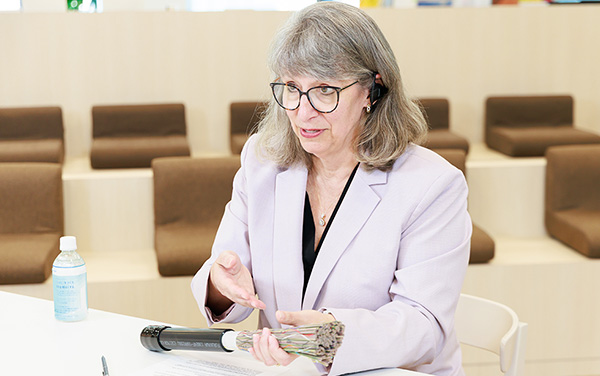
——In such a massive organization, what approach do you take to change people’s mindsets?
Holly: I think at the end of the day every employee in every region wants to be part of a winning team.
If we want to change the mindset, we have to find a way to explain to each person in each region why we are doing this, why we need to change, and how this will benefit us. It’s not always obvious to people.
Why do I need to be on a phone call late at night? Why do I need to speak English? People have a lot of questions about why so much change. So we have to help them see what that change contributes to winning.
Fortunately, our first year as Lightera has been very successful from a financial performance and growth perspective. And that’s one of the most effective feedback mechanisms and helps people to say, “Our results are stronger as One Lightera than they were when we worked independently.”
Furthermore, I place great importance not only on town hall meetings and updates on the internal website, but also on traveling all the time to visit our different sites and to try to meet people one on one. This week, I plan to visit four of our Asia Pacific entities, creating opportunities for employees to directly tell me what is going well and what the challenges are. We have to be present, not just sit at our desks. It’s also about building trust with the customers, as well as about building trust with our employees.
Listening to customers about their challenges drives Lightera’s innovation
——What do you think is the reason you’ve become a company supported by such a diverse range of customers in just one year? What aspects of your products and technology do you believe are highly valued?
Holly: The reason lies in the perfect balance between the trust accumulated over 100 years of history and our innovativeness that always looks toward the future.
The companies that preceded Lightera have continuously pursued breakthrough innovations, first in early communications using copper, recently in fiber development, cable innovation, and yet more recently in connectivity and solutions. That history provides a layer of trust for our customers because they know that we have lots of experience and lots of success.
If I think about some of the more recent innovations that we have been working on in fiber, of course, we are very active in single-mode and multi-mode fiber. More recently, we’ve been doing significant development work in multicore fiber and hollow-core fiber. Furthermore, by pooling the collective strength of the Furukawa Electric Group, we have become capable of providing comprehensive, high-value-added solutions, such as improved thermal efficiency and process differentiation.
——“Safety first” and “Pursuit of innovation.” How do you view the balance between these two?
Holly: No matter how excellent the products or how high the profits, none of that matters if we don’t have a safe work environment for our employees. Furukawa has been very strongly committed to doing what it takes to make our factories safe and to make the application of our products safe.
It is on this solid foundation that we pursue innovation. However, great ideas only matter if we can connect them with the needs of our customers, and that is where we are working very hard to make sure that we’re not innovating for the sake of innovation. We are listening carefully to the problems that our customers have, and we’re trying to develop solutions that will help solve their problems.
——What do you believe are Lightera’s strengths in translating customer needs into tangible products?
Holly: The starting point of our strength is our ability to listen. We don’t always have detailed insight about how the customer wants to use our products and where the market is going. So it is genuinely a partnership where we exchange information.
For example, we sometimes receive extremely challenging requests, such as, “I want to have very high density in my network, but I have very limited space. What is the best way to get maximum bandwidth through a limited channel?” To address such challenges, we engage in repeated dialogue with our engineering department and conduct numerous trials.
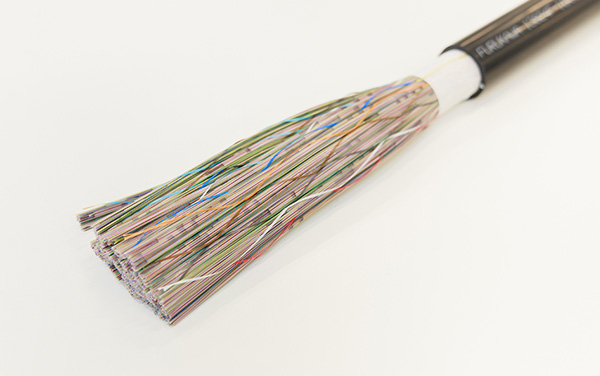
A prime example of this is our ultra-high-count optical fiber cable. Initially, products with around 6000 counts were available on the market, but the customer told us that was nowhere near enough. While some within the company argued that such density is impossible, we decided to give it a try.
As a result, through trial and error, we have succeeded in accommodating an astonishing 13824 fiber count. Very few companies in the world can achieve this, which highlights the many capabilities of Lightera. We responded to our customers’ urgent need to rapidly expand data center capacity not with mere compromise, but with a technological breakthrough.
We try not to say no, but we do try to say, “Can we maybe try something a little different?” when a direct solution is difficult. We always make a commitment to moving forward alongside our customers. This mindset of continuously taking on new challenges is the very source of our strength.
However, we have to make sure that our product is not something we can simply make in the laboratory. We have to produce it stably at a high quality and elevate it to a level suitable for full-scale industrialization. This power of industrialization is fundamental to the professionalism we take pride in.
——Please tell us about your future outlook.
Holly: I repeat, the first and most important thing is that we keep our people safe. Ensuring that not a single employee is injured is our non-negotiable policy. We will continue to ensure that we maintain a safe workplace environment as our top management priority.
Strategically, we will maximize growth while appropriately managing risks. I think all of us have lived through telecom and other bubbles, and there are many people today who are concerned about an AI bubble. But we remain focused on fulfilling our commitment to anchor customers with whom we can build long-term relationships, without being swayed by temporary trends.
On the technological front, while we will certainly pursue cutting-edge technologies such as hollow-core optical fiber, we will also focus on improving the ease of use of our products. One example of this is the intermittent connection-type ribbon fiber core technology used in our ultra-high-count optical fiber cable, the rollable ribbon cable. While conventional flat ribbon cable offered the convenience of bulk connection, they had the drawback of taking up significant space. We developed a structure that bundles the fibers while allowing them to be rolled up flexibly, enabling significant space savings and faster installation. We believe that such fundamental innovations, which prioritize convenience for installers and end users, are what will solidify demand for our products in the market.
And what I conveyed to our employees at the fiscal year 2026 kickoff meeting was that they need to think about how to do innovation in everything that they do.
Innovation is not just in our research and development. Maybe it’s about using AI instead of taking minutes at every meeting, using AI to expedite financial closing processes, or using a translation tool to simplify the communications between our different locations. There are opportunities for learning and improvement everywhere.
Sharing best practices across all fields, such as manufacturing, HR, and accounting, and continuously evolving day by day: this is the engine that drives Lightera moving forward.
——Finally, please give a message to our readers.
Holly: The first message is that it really is a privilege to be in this industry and to have the opportunity to lead Lightera with the exciting market environment that we’re facing.
As exciting as the market is today, we have an obligation to build on the legacy of Furukawa that has been established over almost 140 years. We have to make sure that the things that we’re doing today are not only building success today. While improving our business performance, we also seek to be sustainable, not only contributing to the global environment but also keeping the relationships that we build as we try to serve our customers better than anyone else.
It’s a unique time, it’s a challenging time, but again, it’s truly a privilege to be in this industry at this time. I am deeply grateful to our customers, who have supported us along the way, and to our employees, who walk alongside us with passion. I have incredible respect for the employees that we have on our team, because they are some of the smartest and most enthusiastic people that I’ve ever worked with, and that makes it exciting every day to wake up and start the day and be part of this great adventure. I look forward to contining this wonderful journey withall of you.


 Share
Share Tweet
Tweet Share
Share