

The On-Board Computer (OBC) is a central component that controls various components such as transceivers and attitude control modules. Furukawa Electric is developing an OBC with high signal and computation processing capabilities, considering rewrites in orbit. This supports the rapid development of satellites with diverse configurations and missions.
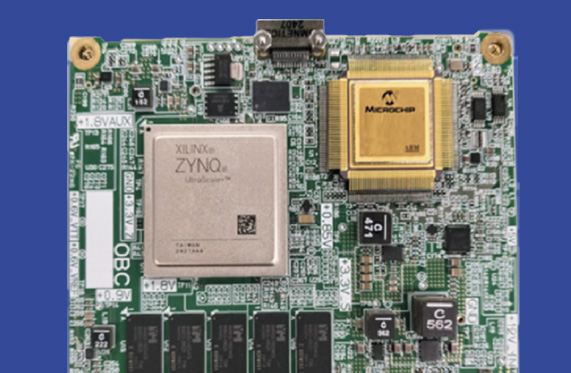
Features
- Compact and lightweight
- Equipped with Xilinx FPGA
- Allows arbitrary program rewrites from the ground
- High signal and computation processing capabilities
- Easy connection with interface boards and various components
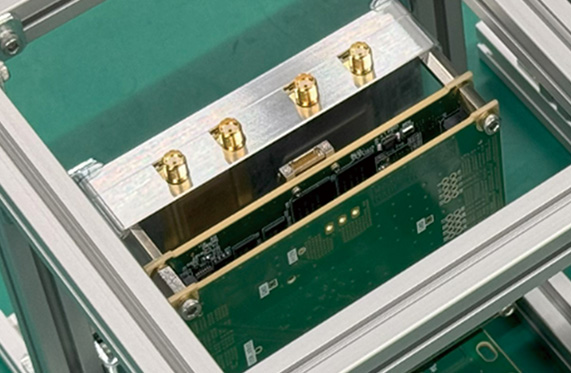
Connected to multiple components, allowing flexible system configuration.
Specifications
| Item | Specification | |
|---|---|---|
| Mass | Approx. 80g | |
| Size | 100 × 87.2 × 20 mm | |
| MPU | CPU | Arm Cortex-M7 |
| Device | Radiation-resistant product | |
| SoC | CPU | Arm Cortex-A53 |
| Device | Zynq UltraScale+(Xilinx) | |
| Item | Specification | |
|---|---|---|
| MPU | UART | 3 ch MAX |
| USART | 3 ch MAX | |
| TWI | 3 ch MAX | |
| CAN | 2 ch MAX | |
| MII | 1 ch MAX | |
| DA | 2 ch MAX | |
| AD | 10 ch MAX | |
| SoC | PS_CAN | 2 ch MAX |
| PS_SPI | 1 ch MAX | |
| PS_I2C | 2 ch MAX | |
| PS_GPIO | 15 ch MAX | |
| PS_GTR | REFCLK 2 ch / GTR 4 ch | |
| PL_GTH | REFCLK 6 ch / GTH 12 ch | |
| PL_GMII | Supported | |
| PL_HPIO | 1.8V:100 ch MAX | |
| PL_HDIO | 3.3V:18 ch MAX | |
| USB 2.0 | 1 ch | |
| Item | Specification | |
|---|---|---|
| MPU | FlashROM | QSPI 512 Mbyte × 2 |
| MRAM | SPI 4 Mbit | |
| Zynq UART | 1 ch | |
| Zynq SPI | 1 ch (Boot/PL switch) | |
| Zynq I2C | 1 ch (Base connector supported) | |
| OBC Internal Sensors | Temperature ×1 (ZYNQ), Overcurrent monitoring ×4 | |
| debug UART | 1 ch | |
| debug SWD | 1 ch | |
| SoC | FlashROM | QSPI (Shared with SPI) |
| DDR-SDRAM | 4 GB + ECC | |
| eMMC | 32 GB × 2 | |
| MRAM | SPI 4 Mbit | |
| USB 2.0 | 1 ch (via PHY) | |
| MPU UART | 1 ch | |
| MPU SPI | 1 ch(PL) | |
| MPU I2C | 1 ch(PL) | |
| debug JTAG | 1 ch | |
Supported OS: FreeRTOS, PetaLinux, etc.
Middleware: C2A, etc.
Development Languages: C Language, C++, etc.
Development Environment: MPLAB, Vitis, etc.
Benefits
- Can be mounted on small to medium-sized satellites
- Enables high-speed transmission and reception of large data such as images
- Ensures compatibility with various ground stations
- Supports achieving advanced mission objectives
※ Technical information (values) in this document are typical values and not guaranteed values.
※ The contents of this document are subject to change without notice.
Inquiries about Satellite Components